
HOA Security Patrol: How to Choose the Right Plan for Your Community

Updated: 3 days ago
An HOA security patrol is a licensed security company that checks your community's streets, gates, pools, parking areas and common spaces on a set or random schedule, and reports what it finds to the board or property manager. The right plan depends on your community's size, layout, budget and the problems residents care about most.
This guide is for HOA boards, community managers and property managers in the San Gabriel Valley who are thinking about adding or changing security.
What does an HOA security patrol do?
A typical HOA patrol officer will:
Drive or walk the community and check common areas.
Check that gates, pool areas, clubhouses and gyms are locked after hours.
Look for open garages, broken lights, damaged property and safety hazards.
Watch for trespassing, loitering and suspicious vehicles.
Enforce community rules the board approves, such as parking or pool hours, where allowed.
Call police or 911 when needed.
Write a report after each shift or visit.
Patrol officers do not replace police. Their job is to observe, deter, report and help keep the community running smoothly.
Mobile patrol or on-site guard: which is right for my HOA?
Most HOAs choose one of two options, or a mix of both.
Mobile patrol
A patrol officer visits several times during a shift at random times. This is often the most budget-friendly option and works well for:
Small and mid-size communities.
Communities with a few problem areas, like a pool or a back parking lot.
Boards that want a visible presence without paying for a full-time guard.
Overnight patrols are available in many areas, so contact us to confirm coverage for your community.
On-site security guard
An on-site guard stays in the community for the full shift. This works well for:
Gated communities that need a guard at the gate to check visitors.
Large communities with many entrances.
Communities with ongoing problems that need steady attention.
Events, holidays or busy summer months.
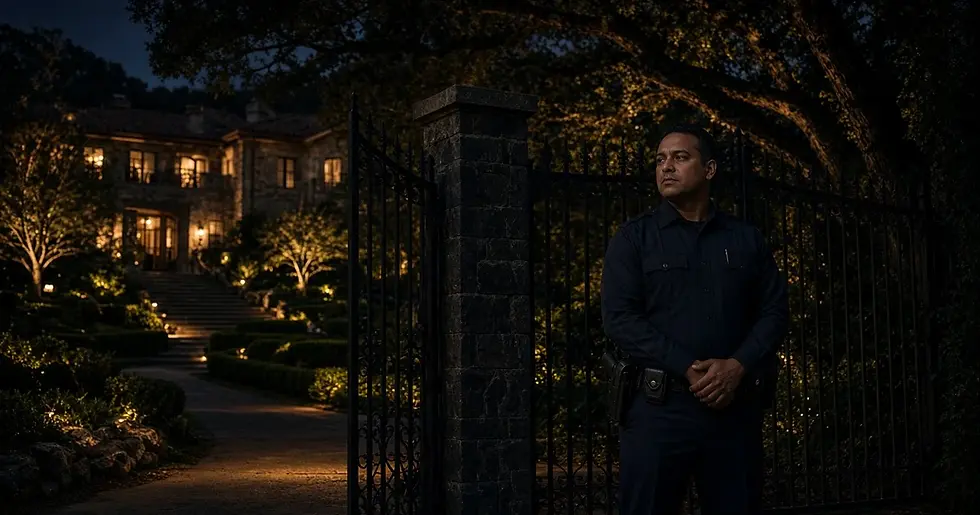
Armed guards and on-site security are available in every city we serve. For larger estates in Pasadena and Arcadia, we also offer Black Label estate protection.
What problems can an HOA patrol help with?
Boards often bring in patrols for issues like:
Package theft and car break-ins. Visible patrols can help deter people looking for easy targets.
Pool and amenity misuse. Officers can check that non-residents are not using the pool or clubhouse after hours.
Parking problems. Officers can document vehicles parked against the rules so the board or manager can follow its parking policy.
Trespassing and loitering. Officers can ask people without permission to leave and call police if needed.
Vandalism. Reports help the board track damage and fix it quickly.
How much does HOA security cost?
Cost depends on the number of hours, how many patrol visits you need, whether you want mobile patrol or an on-site guard, and whether the guard is armed. Many boards start with a smaller patrol plan, review the reports for a few months, and adjust.
The best way to price a plan is a walk-through of the community, so the plan matches real problem areas instead of guesses.
What should an HOA board ask before hiring a security company?
Before your board votes, ask every company these questions:
Is the company licensed by BSIS? In California, security companies need a Private Patrol Operator (PPO) license from the Bureau of Security and Investigative Services. You can check any license on the California Department of Consumer Affairs license search.
Are guards registered and trained? Every guard needs a BSIS guard registration. Armed guards also need a BSIS firearm permit.
What will our reports look like? Ask for a sample. Good reports are clear, timed and easy for the board to read.
Who is our point of contact? You should know who to call with questions or changes.
Can the plan change? Your needs during the summer or holidays may be different from the rest of the year.
What are the contract terms? Read the length, cancellation terms and what is included.
We cover more of these in our guide to the top considerations before hiring a security guard company.
How do we get residents on board with security?
Residents are more likely to support security when they understand it. A few tips:
Share a short summary of patrol reports at board meetings.
Explain what officers can and cannot do.
Give residents a clear way to report concerns to management.
Ask for feedback after a few months and adjust the plan.
Frequently asked questions
Can HOA security guards issue tickets or tow cars?
Security officers can document parking violations and follow the rules your board and property manager set. Towing must follow California law and your HOA's own rules, so talk to your manager and legal advisor before setting a towing policy.
Can an HOA patrol detain people?
Security officers are not police. Their role is to observe, report and call police when needed.
Do you serve HOAs in Glendora and Pasadena?
Yes. We serve HOAs across the San Gabriel Valley. See our Glendora security page and Pasadena security page to learn more.
Is SGV Patrol licensed?
Yes. SGV Patrol is Licensed, BSIS PPO #17353, and has served the San Gabriel Valley since 2012.
For HOA coverage details, see our HOA security services page.
Get an HOA security walk-through
We will walk your community with your board or manager and suggest a plan that fits your budget. Call SGV Patrol at (626) 727-1592. Calls are answered 24/7.
About the author
Samantha Stephens writes for SGV Security Brief, the blog of SGV Patrol. SGV Patrol is Licensed, BSIS PPO #17353, and has served the San Gabriel Valley since 2012. You can verify the company license on the California DCA license search. Call (626) 727-1592 for a security assessment. Calls answered 24/7.

Comments